
Cannabis capsules are the most predictable way to take cannabis by mouth: a swallowable, pre-measured dose with no smoke, no smell and no taste. You pick a strength, swallow one, and wait, and the waiting is the part that catches people out. Lozenges, which dissolve in the mouth, work faster and fade sooner. This guide covers how both formats behave, what Canadian rules say about their strength, how to read a label and how to start. If you already know your strength, you can browse our cannabis capsules and have them delivered in discreet packaging.
TL;DR
- Swallowed capsules typically start working in 30 minutes to 2 hours and can last 4 to 8 hours, so never take a second dose early.
- Lozenges held under the tongue start sooner, within roughly 15 to 40 minutes, but the effects can still last for hours.
- In Canada, ingested extract products such as capsules are limited to 10 mg THC per unit, and the product class, not the word “capsule”, decides the rules.
- Start low and go slow, take it in the evening in a safe setting, and never drive afterward.
- Check the THC and CBD per unit on the label before you buy, then choose a strength that fits your experience.
Table of Contents
- What cannabis capsules are, and how lozenges differ
- What the Canadian rules say about strength
- How capsules work in the body, and why patience matters
- THC capsules, CBD capsules and balanced formulas
- How to read a Canadian cannabis label
- A start-low routine for your first capsule
- Side effects and who needs extra care
- Lozenges versus capsules: which suits you
- Where our capsules fit
- Our perspective
- FAQ
- Sources
What cannabis capsules are, and how lozenges differ
A cannabis capsule is a small shell, usually gelatin or a plant-based alternative, filled with a cannabis oil or extract. It looks like any supplement pill and is taken the same way. Because every capsule holds the same amount, you know exactly what you are taking, which is hard to say about a gummy cut in half or a hand-rolled joint.
A lozenge is a slow-dissolving candy or tablet. You keep it in your mouth rather than swallow it whole, so part of the cannabinoid is absorbed through the lining of the mouth (called sublingual or oromucosal absorption). One Canadian edibles guide describes lozenges as slower-dissolving than other candies, with an onset of 15 to 30 minutes when held under the tongue and a duration of 2 to 4 hours.
Both fall under the broad label of “oral cannabis”, along with gummies, chocolates and drinks. The difference that matters is the route into your body:
| Format | How you take it | Typical onset | Typical duration |
|---|---|---|---|
| Capsule | Swallowed with water | 30 minutes to 2 hours | 4 to 8 hours |
| Lozenge | Dissolved under the tongue or in the mouth | 15 to 40 minutes | Several hours, up to 12 in some cases |
The timings come from Health Canada’s guidance on using a cannabis product, which gives 30 minutes to 2 hours for swallowed products, a peak at 2 to 4 hours, and 15 to 40 minutes for products dissolved under the tongue, with a peak at 1.5 to 4 hours. It also notes that food in your stomach and other oral medications change the timing.
What the Canadian rules say about strength
You do not need to memorize regulations to shop well, but one rule explains a lot of what you see on shelves. Health Canada sorts ingestible cannabis into classes, and the class depends on how the product is meant to be consumed, not on what the name says. Products consumed like food are edible cannabis, capped at 10 mg THC per package. Extracts, which include oil-filled capsules, can hold up to 1,000 mg THC per package. A name containing “capsule” or “lozenge” does not settle which class a product belongs to.
Health Canada’s legal limits page spells it out for ingested extracts such as capsules: 1,000 mg THC per container and 10 mg THC per unit. That is why you will see packs of capsules with a large total, such as 1,000 mg, that still contain individual capsules of 10 mg or less. The pack strength and the per-capsule strength are two different numbers, and you want the second one for dosing.
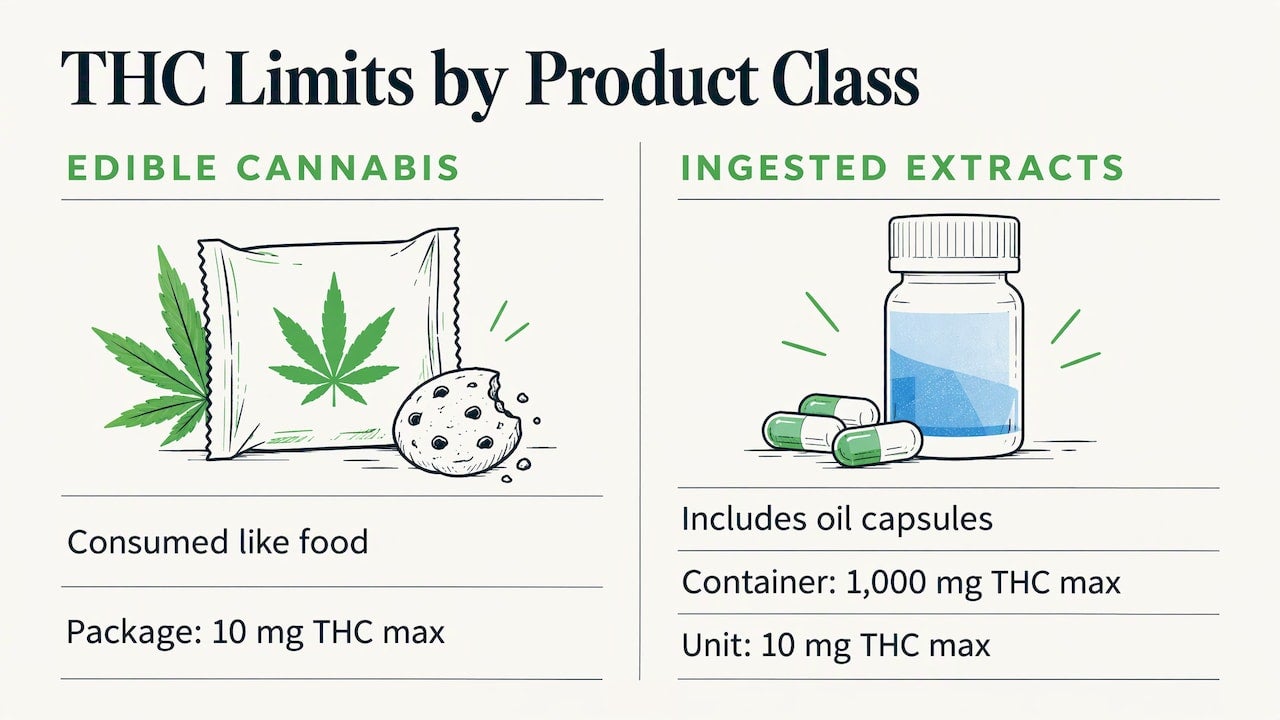
There is a useful reminder in how the government describes the cap. In its final regulations media kit, Health Canada says the 10 mg limit is not a safe dose or a standard serving, and that people respond differently, even from one occasion to the next. Treat 10 mg as a legal ceiling per unit, not as where you should begin.
How capsules work in the body, and why patience matters
When you swallow a capsule, the cannabinoids travel through your digestive system and the liver before they reach general circulation. A peer-reviewed pharmacokinetics review reports that oral THC and CBD have low bioavailability, as low as about 6%, and that oral THC peaks at roughly 120 minutes. The liver also converts oral THC into 11-hydroxy-THC, a psychoactive compound. In plain terms: less of the dose reaches you, it arrives later, and the experience can feel different from smoking or vaping.
The same review notes that dosing under the tongue is absorbed quickly and reduces that liver pass. That is the reason lozenges tend to feel quicker and, per the edibles guide above, milder than an equivalent swallowed dose.
A 2020 review of cannabis pharmacokinetics adds that CBD in capsules shows more variable absorption than oil or sublingual forms, and that CBD stays in the body for a long time, with a half-life estimated at 18 to 32 hours. Practically, that means your first capsule and your fifth may not feel identical, and the effects of daily use build up over days.
The common mistake is the one Health Canada warns about: delayed onset leads people to take more, and delayed effects can cause overconsumption and cannabis poisoning, with panic, paranoia and hallucinations. If you feel nothing after 45 minutes, that is normal for a capsule. Wait the full two hours before deciding anything.
THC capsules, CBD capsules and balanced formulas
The label tells you which cannabinoid does what you want.
- THC capsules are the intoxicating option. They are the usual choice for evening relaxation and sleep-time routines.
- CBD capsules are not intoxicating in the way THC is, but CBD products can still contain THC, and Health Canada says that THC can cause side effects. Read the THC figure even on a product sold as CBD.
- Balanced or blended capsules combine THC with CBD or another cannabinoid, such as CBG. The ratio changes how the product feels, so note it when you find one you like.
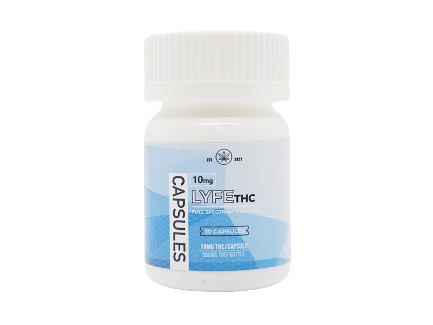
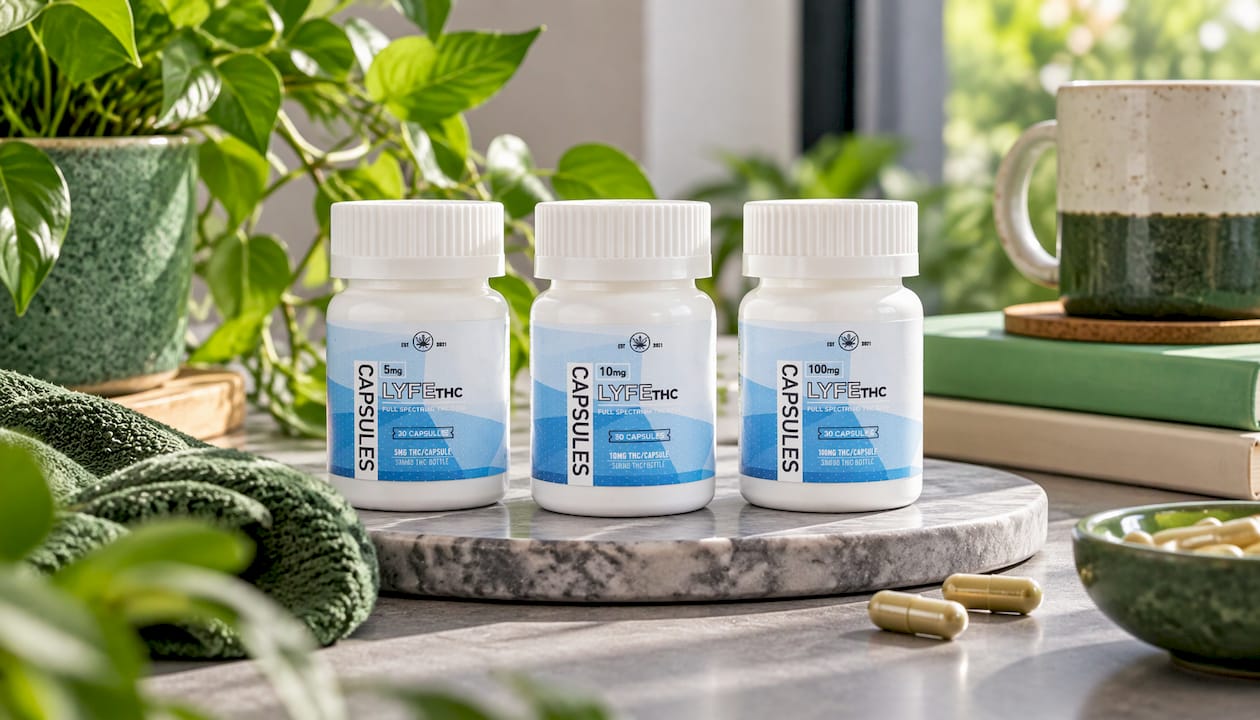
At XpressGrass, the capsule range includes LYFE THC capsules in 5 mg, 25 mg and 100 mg formats, a higher-strength Buddhas THC capsule pack, and Trichome Gardens Daytime Formula capsules with THC and CBG. Each product page shows its own strength figures, so compare the per-capsule number against the pack total before you add one to your cart.
How to read a Canadian cannabis label
Every legal product carries the same label elements, which makes comparing easy. According to Active Aging Canada’s guide to Canadian labelling, legal products show THC and CBD per unit and in total inside a white box, carry the standardized cannabis symbol, and display a two-sentence health warning on a yellow background.
When you hold a bottle, check in this order:
- THC per capsule. This is your dose. A bottle’s total number tells you nothing about a single serving.
- CBD per capsule. This shows whether the product is THC-only or balanced.
- Number of capsules. Divide the total by the count to confirm the per-capsule figure.
- Format. Capsule, soft gel, lozenge or tablet affects how quickly it works.
- Storage and child-resistant packaging. Keep the product in it.
Online, the same details should sit on the product page. Shopping online is convenient precisely because you can compare strengths side by side without standing at a counter.
A start-low routine for your first capsule
Health Canada’s guidance is built around one idea: start low and go slow. For people using cannabis medically, it advises beginning at 2.5 mg THC once a day for eaten, drunk or sublingual products, or 25 mg CBD a day split into two or three doses, and it notes there is no known maximum dose for any condition and that higher doses raise the risk of side effects.
Here is how that translates into a routine:
- Choose a low strength. Many first-time users are best served by the lowest strength available, such as a 5 mg or lower capsule, and some people split nothing and simply start there.
- Pick a safe setting. Take it at home, in the evening, ideally with someone you trust nearby.
- Take it consistently. Health Canada suggests taking it at the same time and under the same conditions, so you can tell what the dose is doing.
- Wait at least two hours before considering more. Peak effects can take 2 to 4 hours and the whole experience can last up to 8.
- Keep notes. Write down the strength, the time and how you felt.
- Raise the dose gradually. Only change one thing at a time, and only after the previous dose has fully worn off.
CAMH’s Cannabis Care Guide for Pharmacists suggests slower titration for clinical use: THC starting doses of 1 to 2.5 mg daily, adjusted every 5 days, and CBD at 2.5 to 5 mg daily, adjusted every 3 days. It also observes that capsules suit people who are already stable on a minimal effective dose, since the fixed unit makes fine titration harder. That is a good argument for finding your amount first, then moving to capsules for convenience.
If you take other medications, are pregnant or breastfeeding, have a heart condition or a history of psychosis, speak to your doctor or pharmacist before using any cannabis product. Health Canada guidance also covers how a practitioner can monitor dosing and effects with you.
Side effects and who needs extra care
Health Canada’s consumer information lists the immediate effects you might notice: euphoria, dizziness, faster heart rate, anxiety, increased appetite, impaired memory and attention, dry mouth, red eyes and drowsiness. Serious effects such as psychotic symptoms, extreme confusion, severe anxiety and hallucinations are possible, especially after taking too much.
A few practical points follow from this:
- Do not drive or operate machinery. Health Canada notes that some impairment can last up to 24 hours after use, and capsules sit at the long end of the duration range.
- Avoid mixing with other intoxicating substances. Alcohol and cannabis together raise the risk of overdoing it.
- Older adults should be extra careful. Active Aging Canada points out that THC affects coordination, balance and depth perception, so dizziness and drowsiness can increase the risk of falls.
- Store securely. Keep capsules in the original child-resistant package, out of reach of children and pets. CAMH suggests a lock box.
Capsules are easy to mistake for supplements, so label them and keep them away from other pill bottles.
Lozenges versus capsules: which suits you
Choose by what you need from the experience.
- You want something fast and shorter: a lozenge held under the tongue starts sooner and, for many people, feels milder than a swallowed dose.
- You want a long, steady, discreet dose: a capsule has no flavour or smell, looks like a supplement, and runs for hours, which suits evenings and sleep.
- You want to fine-tune a dose by small steps: a low-strength capsule such as 5 mg lets you build gradually.
- You like a flavoured treat: edibles such as gummies are the closer match. We cover those in our guide to gummy candy edibles and browse them in our edibles category.
If you are moving up from capsules to stronger products, our article on high-dose edibles explains strength, safety and smart dosing.
Where our capsules fit
XpressGrass is an online dispensary serving customers across Canada. For capsules, three things matter to most people: choice of strengths, privacy and speed. Our capsule category lists several strengths so you can start low and step up. Orders ship in discreet packaging focused on privacy, and same-day delivery is available across Canada. Frequent buyers can also earn rewards through our loyalty program.
Start with our capsules category, or go straight to a lower-strength option such as the LYFE 10 mg THC capsules if 5 mg feels too light for you.
Check each product page for the THC and CBD per capsule before you order, and keep your first dose small. You can see everything we carry, including flower, edibles, extracts and vapes, on the XpressGrass homepage.
Our perspective
Most of the trouble people have with oral cannabis comes from timing, not strength. A capsule feels like nothing for an hour, and that is when people reach for a second one. We built our capsule range around that problem: a spread of strengths, from low to high, so you can begin at a dose that suits you and move up deliberately, rather than guessing with a product that has only one setting.
We also think buying cannabis should be as private and as simple as ordering anything else. That is why we focus on discreet packaging, same-day delivery across Canada and a loyalty program that rewards people who come back. A capsule is a small, quiet product, and the way it reaches you should be quiet too.
Our advice is the same as Health Canada’s: read the label, start low, go slow, and keep a note of what works for you.
the author
FAQ
How long do cannabis capsules take to work?
Swallowed capsules usually start working within 30 minutes to 2 hours, peak at about 2 to 4 hours and last 4 to 8 hours, according to Health Canada. Food in your stomach and other oral medications can change the timing. Wait at least two hours before taking more.
What is the difference between THC lozenges and THC capsules?
A lozenge dissolves in your mouth, so part of the dose is absorbed under the tongue and starts sooner, typically in 15 to 40 minutes. A capsule is swallowed and goes through digestion and the liver first, so it starts later and lasts longer. Capsules are also flavourless and discreet.
How strong can a cannabis capsule legally be in Canada?
Health Canada limits ingested extract products such as capsules to 10 mg THC per unit and 1,000 mg THC per container. Edible cannabis is capped at 10 mg THC per package. The cap is a legal limit, not a recommended dose, so begin with less than the maximum.
Can CBD capsules still affect me like THC?
CBD products can contain THC, and Health Canada notes that this THC can cause side effects. Always check the THC per capsule on the label, even on a product sold mainly for its CBD. Take it in a safe setting and do not drive afterward.
Can I use capsules for a medical reason?
Health Canada advises confirming that a product matches what your health care practitioner recommended and working with them to monitor your dose and effects. Talk to your doctor or pharmacist before starting if you take other medications or have a health condition.
Sources
- Health Canada: Classification of ingestible cannabis products
- Health Canada: Cannabis for medical purposes, using a cannabis product
- Health Canada: Reduce your risk, choose legal cannabis
- Health Canada: Consumer information, cannabis
- Health Canada: Final regulations media kit
- The pharmacokinetics and the pharmacodynamics of cannabinoids (PMC)
- Mechanisms of Action and Pharmacokinetics of Cannabis (PMC)
- CAMH: Cannabis Care Guide for Pharmacists
- Active Aging Canada: Cannabis and Older Adults booklet
- TheCannaSchool: Types of edibles guide