

Many Canadians reach for cannabis to take the edge off, and plenty report that it helps. The research is more mixed, and the details matter: dose, THC level, CBD content, how often you use and the form you pick. In short, lower THC, a balanced or CBD-leaning profile, a small first dose and patience with edibles give you the best chance of a calm experience. Talk to a health care provider if anxiety is a regular part of your life.
TL;DR
- Low THC doses can calm, while high doses can bring on anxiety and racing thoughts. Health Canada describes THC as having this two-way effect on mood.
- Balanced THC:CBD or CBD-dominant products tend to suit anxious users better than THC-heavy ones.
- Start low and go slow: 2.5 mg THC for edibles, 1 to 2 inhalations for inhaled products, and at least four hours before a second serving of an edible.
- Daily or near-daily use is linked to more frequent anxiety, so keep use occasional and speak with your doctor or pharmacist if you are using cannabis to cope.
Table of Contents
- What the evidence says about weed and anxiety
- Why THC can calm you or make things worse
- Cannabis strains for anxiety: reading the label
- Flower, edibles, vapes and tinctures: how the format changes the experience
- A careful way to start
- When to talk to a professional
- Shop calmer, with options that fit
- FAQ
- Sources
What the evidence says about weed and anxiety
The honest answer is that the science is unsettled. Health Canada states that cannabis use has not been found to improve mental health over time, and that daily or near-daily use can make anxiety and depression more frequent. At the same time, many people find short-term relief, and researchers are still sorting out who benefits and under what conditions.
A few findings help frame it:
- A 2025 systematic review in Psychiatry Research found that 70% of the 13 highest-quality studies reported improvement in conditions including generalized anxiety disorder, social anxiety disorder and PTSD, while 30% reported negative results. The authors say long-term benefits remain unclear.
- The Cannabis Evidence synthesis rates the evidence that CBD may improve anxiety symptoms as low certainty, and says it is unclear whether THC affects anxiety at all.
- The Canadian Centre on Substance Use and Addiction (CCSA) notes limited high-quality evidence for THC, CBD or other cannabinoids in treating anxiety disorders, while roughly 90% of people who use cannabis for anxiety report that it works for them.
- The College of Family Physicians of Canada says there have been no controlled studies of dried cannabis for anxiety disorders, and that the evidence for pharmaceutical cannabinoids, such as an oral pure-CBD extract for social anxiety, is stronger.
What does this mean for you? Cannabis is not a replacement for care from a professional, and the same plant that relaxes one person can unsettle another. The rest of this guide is about stacking the odds in your favour.
Why THC can calm you or make things worse
Health Canada’s guidance for health care professionals says THC has biphasic effects on mood: low doses can ease anxiety and lift mood, while high doses can produce anxiety and lower mood. That one idea explains most of the “it helped last week, now it makes me paranoid” stories.
A few things shift where you land on that curve:
- Dose. The CFPC notes that acute use can trigger anxiety and panic attacks, and that high doses actually worsen anxiety.
- THC strength. Health Canada treats products above 10% THC, or 10 mg per serving, as high, and as more likely to cause mental health harms.
- Frequency. The same Health Canada page links daily or near-daily use over time to more frequent anxiety and depression.
- Your starting point. Healthline reports that people already prone to paranoia and anxious thoughts are more likely to experience both when they use cannabis.
- Social anxiety in particular. CCSA’s Closing the Gaps report notes that social anxiety disorder is linked to cannabis dependence at more than twice the rate seen with other anxiety disorders, so pay attention to your own patterns.
If you feel more anxious since you started using
This is a common experience, and it is worth taking seriously. Health Canada says you are more likely to recover from long-term anxiety and depression if you reduce or stop using cannabis, and that cutting back can reverse some or all of the effects on mental health. The CFPC adds that regular users may notice worse anxiety in the first days after stopping, as an early withdrawal symptom, and that it resolves with time. Spacing out your use, lowering your dose or switching to a lower-THC product are all reasonable first steps. If it does not settle, a family doctor or pharmacist can help.
Cannabis strains for anxiety: reading the label
People often search for the one “best strain” for anxiety. Strain names are a loose guide at best. The numbers on the label tell you far more: THC percentage, CBD percentage and, for edibles, milligrams per serving.
Here is what the guidance and research point to:
- Lower THC. The CFPC recommends that physicians consider authorizing only lower-strength strains for patients with anxiety, and consider low-THC or CBD-only strains.
- Balanced THC:CBD. Health Canada’s guidance says cannabis with equal proportions of CBD and THC is associated with softening the mood disturbances seen with THC-predominant cannabis.
- CBD-dominant options. A Quebec study of 585 patients followed over 12 months found that those on THC-dominant products saw less improvement in anxiety and well-being than those on CBD-dominant or balanced products.
| Profile | What to look for | Why people pick it for anxiety |
|---|---|---|
| CBD-dominant | High CBD, THC near zero or very low | No intoxication; the most studied option for anxiety symptoms |
| Balanced | Roughly equal THC and CBD | CBD may soften the edge THC can add |
| Low-THC | Under 10% THC, or under 10 mg per serving | Stays on the gentler side of the dose curve |
| THC-dominant | High THC, little CBD | Greater chance of racing thoughts, especially at higher doses |
If you want to understand the two compounds better, our guide to the difference between CBD and THC covers it in plain terms, and our list of high-CBD strains available in Canada is a handy starting point for browsing.
Terpenes such as linalool and limonene often get credit for calming effects in strain write-ups. We treat that as a reason to enjoy an aroma you like, not as a substitute for checking cannabinoid numbers.
Flower, edibles, vapes and tinctures: how the format changes the experience
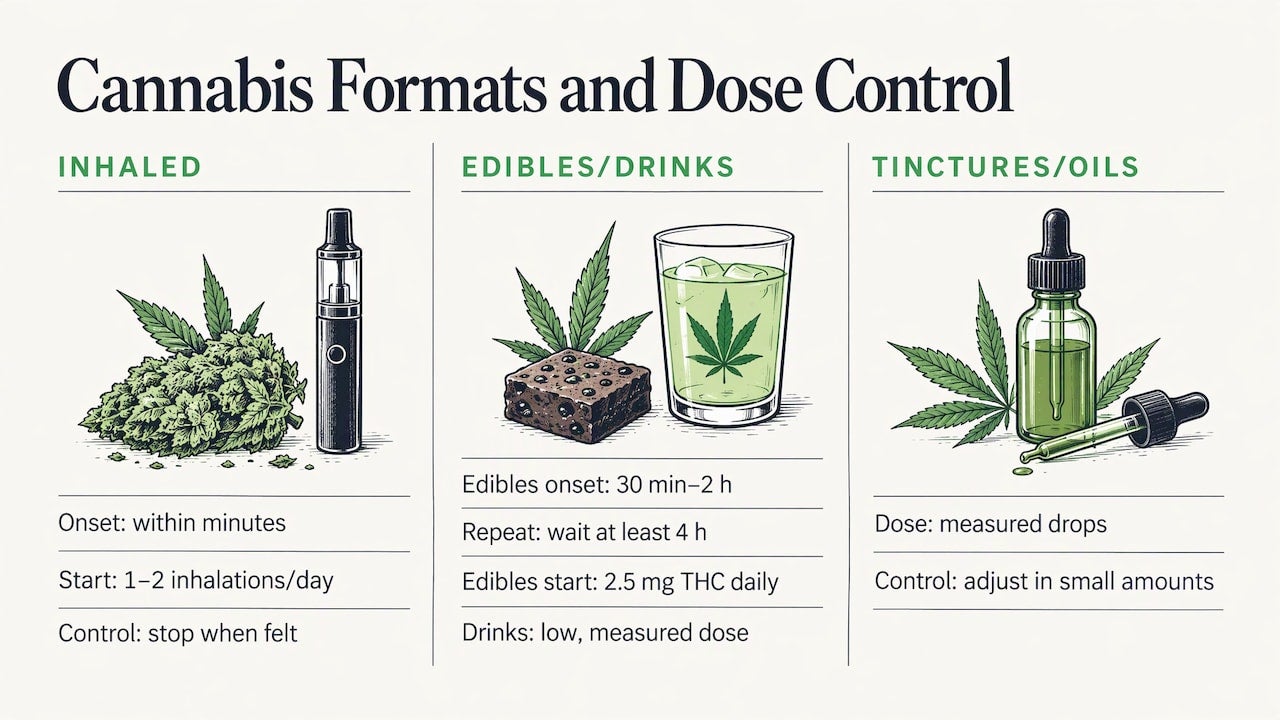
The form you choose changes how fast the effect arrives and how easy it is to control your dose.
Inhaled flower and vapes act within minutes, so you can feel the effect and stop. Health Canada’s medical cannabis guidance suggests starting with one to two inhalations per day for inhaled products. Hybrid flower with a moderate THC level is a reasonable place to begin, and you can browse hybrid flower with the THC and CBD figures listed.
Edibles give a precise, measured dose but a slow onset. The Province of Manitoba advises waiting at least four hours before a second serving, because edibles can take between 30 minutes and two hours to take effect. Most bad experiences with edibles come from taking more because nothing seems to be happening. Health Canada’s guidance suggests starting at 2.5 mg of THC once a day for oral products. Our piece on cannabis edibles for anxiety goes deeper, and CBD edibles: five things to know is useful if you want to skip THC altogether.
Tinctures and oils sit in between: you measure drops, so adjusting by small amounts is easy. Both THC and CBD versions are available as cannabis tinctures.
Beverages offer a low, measured dose in a familiar format, though they share the same wait-before-repeating rule as other edibles.
A careful way to start
This routine applies the Canadian guidance above. It is general information, not a prescription.
- Check the label first. Pick a product under 10% THC, or under 10 mg per serving, or one with CBD in the mix.
- Start with the smallest dose. That means 2.5 mg THC for an edible, or one or two inhalations for flower or a vape.
- Wait. Give inhaled products several minutes and edibles at least four hours before you take more.
- Choose a calm setting. A familiar place and a trusted person nearby make a rough moment easier to ride out.
- Skip alcohol and other substances. Health Canada advises against combining cannabis with them.
- Keep it occasional. Daily or near-daily use is where the link to more frequent anxiety shows up.
- Keep notes. Write down product, dose, time and how you felt. A pattern of getting more anxious is useful information for you and your provider.
If you have a personal or family history of mental health disorders, Health Canada advises avoiding cannabis. If that applies to you, please talk to a health care provider before you buy.
Pairing cannabis with other ways to unwind
Many of our customers like to build a short evening routine around their product: dimmed lights, a warm shower, slow breathing. Scent can be part of that, and ideas for essential oils for relaxation can help you set up a calming space at home. Healthy coping skills matter too: Manitoba’s health guidance notes that using cannabis to self-medicate anxiety rather than building coping skills can make recovery harder, so treat your product as one part of a wider routine.
When to talk to a professional
Speak with your doctor, nurse practitioner or pharmacist if:
- you are using, or thinking about using, cannabis to manage anxiety or depression. Manitoba’s health guidance says to talk to your health care provider in this case;
- your anxiety, panic or low mood gets worse after using cannabis;
- you take other medications, since a pharmacist can check for interactions;
- you feel you need cannabis daily just to feel normal.
If you feel unsafe or in crisis, call 9-8-8, Canada’s suicide crisis helpline, or your local emergency number.
Our perspective
We hear the same story from many customers: they want to feel more relaxed, but they do not want to feel foggy, jumpy or out of control. That is why we think the best way to shop for this need is label-first. Check the THC and CBD numbers, begin with a small amount and let the format match how you like to use it.
We built Xpressgrass around that kind of informed, low-pressure shopping. Our catalogue spans flower, edibles, extracts, vapes, tinctures and a dedicated CBD category, so you can choose a CBD-forward or balanced product as easily as anything else. Our discreet packaging is designed to keep your order private, and same-day delivery is designed to save you a trip when you are ready to restock.
Our loyalty program is meant to reward the regulars who come back, and we would rather you buy a little, learn what suits you and return than load up on something you are unsure about. Our own view is that careful, measured use is what makes cannabis a good experience.
the author
Shop calmer, with options that fit
If you are ready to browse, start with the categories that make low-dose, label-first shopping easy: CBD products, edibles with clear milligram doses, and hybrid flower. Orders ship in discreet packaging, and same-day delivery is available across Canada. You can see everything on the Xpressgrass homepage.
Regular customers can also join our loyalty program, which rewards frequent buyers.
FAQ
Is weed good for anxiety?
It depends on the person, the dose and the product. Many people report short-term relief, and a 2025 review found most of its highest-quality studies reported improvement, but long-term benefits remain unclear. Health Canada also notes that cannabis use has not been found to improve mental health over time and that daily use is linked to more frequent anxiety.
Why does weed make my anxiety worse sometimes?
THC works in both directions: low doses can soothe, while higher doses can trigger anxiety and paranoia, according to Health Canada. Strong products, big edible doses and frequent use all raise the odds. Try a lower-THC or balanced THC:CBD product, a smaller dose, and more time between uses.
Which cannabis strains are best for anxiety?
Look at the cannabinoid numbers rather than the strain name. Canadian guidance points toward lower-THC products, and a Quebec study found CBD-dominant or balanced products were linked to better anxiety outcomes than THC-dominant ones. Start with a small dose either way.
How long should I wait between edible doses?
At least four hours, according to the Province of Manitoba. Edibles can take from 30 minutes to two hours to kick in, so taking more too soon is the most common way people end up overdoing it.
Sources
- Cannabis and mental health, Health Canada
- Cannabis and cannabinoids for health care professionals, Health Canada
- Information on the use of cannabis for medical purposes, Health Canada
- Medicinal cannabis in the management of anxiety disorders, Psychiatry Research, 2025
- Cannabis for Anxiety and Mood Disorders, Cannabis Evidence
- Clearing the Smoke on Cannabis, CCSA 2024 update
- Closing the Gaps: Cannabis Research Summary Report, CCSA
- Authorizing Dried Cannabis for Chronic Pain or Anxiety, College of Family Physicians of Canada
- Authorization Patterns, Safety, and Effectiveness of Medical Cannabis in Quebec
- Good and Bad Experiences (Cannabis), Province of Manitoba
- Long-Term Risks of Cannabis Use, Province of Manitoba