


Many people reach for weed when they feel sick, and the research gives a clear picture of why. THC and other cannabinoids act on the body’s own nausea-control system, and in trials they have helped people with the hardest-to-treat nausea, such as nausea from chemotherapy. The practical choices that matter are the THC and CBD content, the format, and a low starting dose. This guide covers all three, plus the safety points worth knowing before you order. We also touch on pain, since many readers ask about both.
TL;DR
- Cannabinoids can calm nausea because they act on the body’s own receptors that control vomiting, and trials in chemotherapy patients showed clear gains over placebo.
- In a large self-reported study, products labeled sativa or hybrid outperformed those labeled indica for nausea, and higher-THC, lower-CBD flower tended to bring more relief.
- Start low and go slow: dizziness, sedation and feeling high are the most common side effects.
- Daily heavy use can bring on cannabinoid hyperemesis syndrome (cycles of vomiting), so keep use moderate and see a doctor if vomiting becomes cyclical.
- Pregnant people and anyone with persistent vomiting should talk to a doctor before using cannabis.
Table of Contents
- Why weed can settle nausea
- What trials show for chemotherapy nausea
- What about everyday nausea?
- Indica, sativa or hybrid: which works best for nausea?
- What about weed for pain?
- Using weed for nausea more safely
- A note on the rules in Canada
- Our perspective
- Get what you need, delivered discreetly
- FAQ
- Sources
Why weed can settle nausea
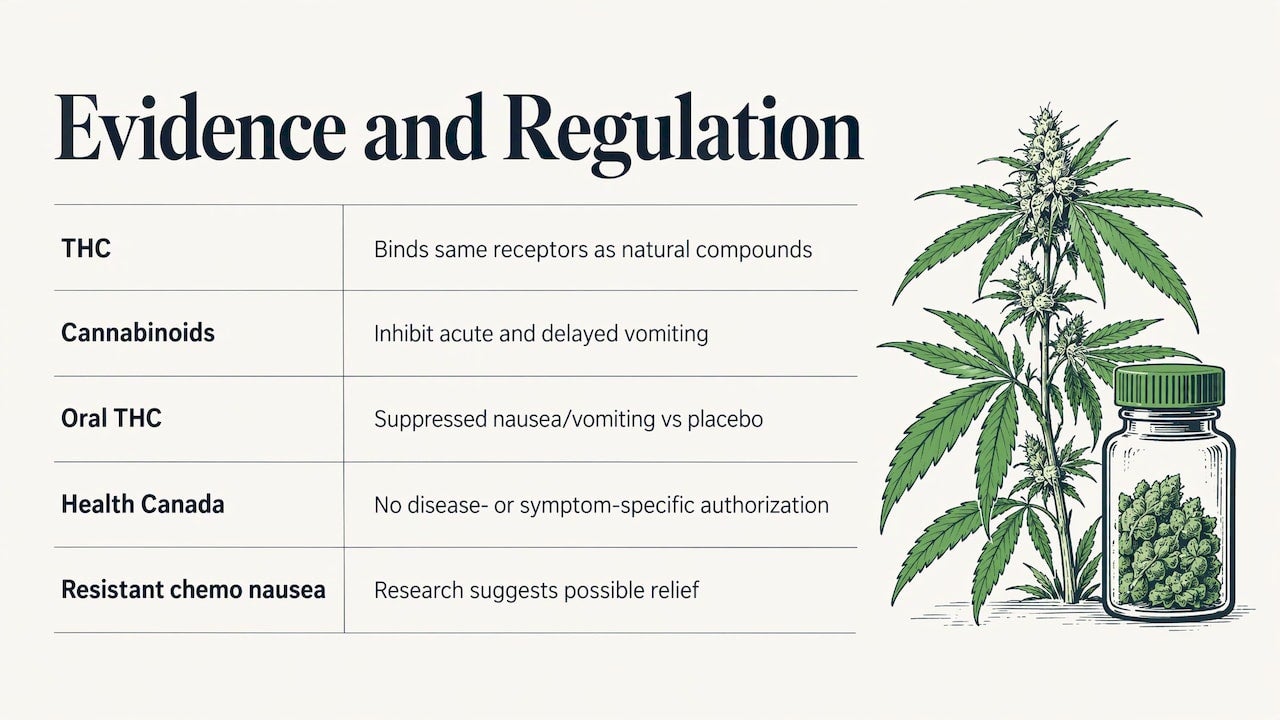
Your body has an endocannabinoid system, a network of receptors and natural compounds that helps regulate appetite, mood and the vomiting reflex. THC, the main active compound in weed, binds to the same receptors.
A review of the science by Sharkey, Darmani and Parker explains that plant-derived, synthetic and the body’s own cannabinoids all inhibit vomiting in humans and animal models, and that they block both acute and delayed vomiting. In cancer patients, oral THC significantly suppressed nausea and vomiting compared with placebo.
Canada’s regulator takes a measured line. Health Canada’s medical-purposes page, updated January 22, 2026, says it has not authorized cannabis products for any specific disease or symptom. It adds that available research suggests cannabis might relieve severe nausea and vomiting from cancer chemotherapy that does not respond to conventional treatment. It names chronic pain, mainly neuropathic pain, and end-of-life symptoms in the same list.
What trials show for chemotherapy nausea
The strongest evidence is for nausea caused by chemotherapy. Three sources are worth knowing.
The Cochrane review. Cochrane’s review of 23 randomized trials found cannabis-based medicines raised the chance of having no vomiting at all (a relative risk of 5.7) and no nausea and vomiting (relative risk 2.9) compared with placebo. The reviewers concluded these medicines may be useful for chemotherapy nausea that is hard to treat.
The Canadian-relevant meta-analysis. A 2018 review of reviews published in CMAJ found a number needed to treat of 3 for control of chemotherapy-related nausea and vomiting. About 47% of people on cannabinoids reached control, against 13% on placebo. In plain terms, for every three people treated, one more got control than would have on a placebo.
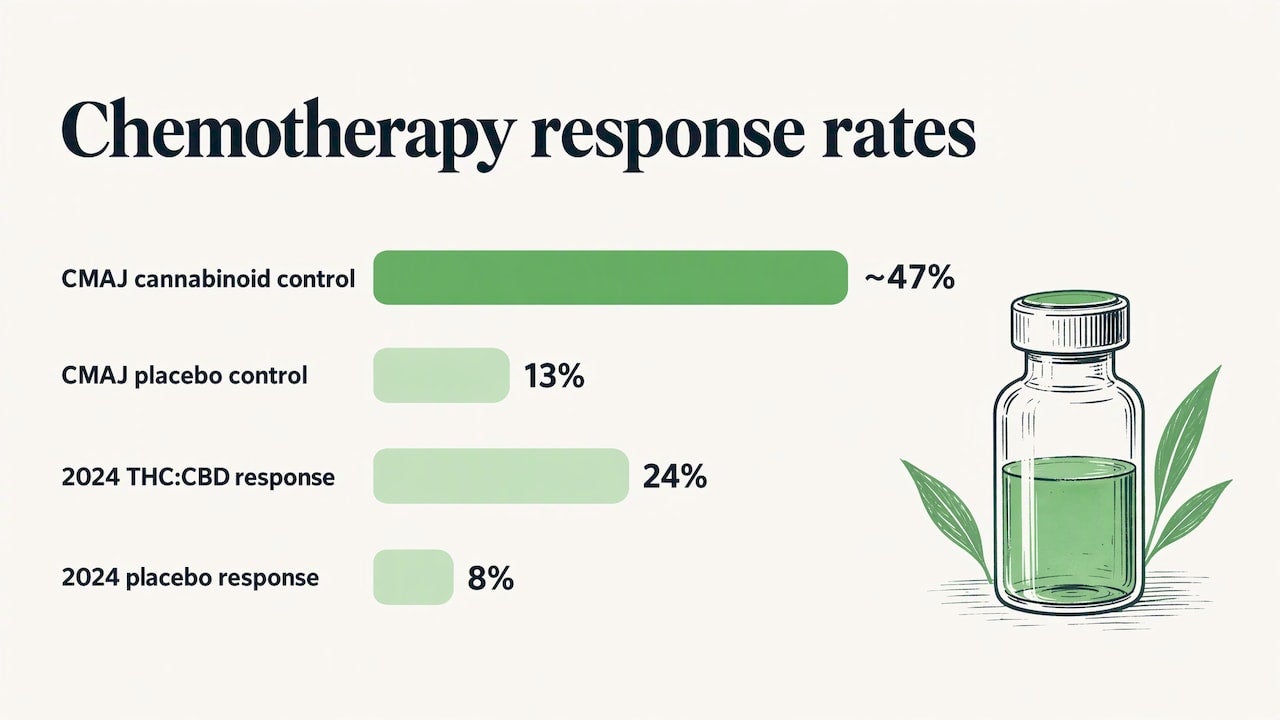
A recent trial. In a 2024 trial in the Journal of Clinical Oncology, people whose nausea persisted despite standard anti-nausea drugs received an oral THC:CBD extract or placebo. Complete response rose from 8% on placebo to 24% on THC:CBD. An accompanying editorial noted that the 16-point gain exceeded the 10% threshold considered important enough to consider changing guidelines.
If this is your situation, our guide to how cannabis helps chemotherapy-induced nausea goes deeper. Anyone in cancer treatment should tell their oncology team before adding cannabis, since they can time it around your other medications.
What about everyday nausea?
Most people searching this phrase are not in chemotherapy. They have nausea from a stomach bug, a migraine, stress or a poor appetite. The clinical trials above focus on cancer treatment, so they do not tell you exactly what to expect for these causes.
What we do have is real-world data. A 2022 study of the Releaf App followed 886 people across 2,220 sessions in which they used cannabis for nausea. Of those, 96.4% reported symptom relief within an hour, an average drop of 3.85 points on a 0 to 10 scale. This was self-reported, not a controlled trial, but it shows how consumers actually experience cannabis for nausea.
If your nausea comes with a specific condition, these related guides may help: cannabis for migraines, cannabis for Crohn’s disease and CBD for IBS.
Indica, sativa or hybrid: which works best for nausea?
Shoppers want a simple rule, so here is what the data says and what it cannot say.
In the same Releaf App study, products labeled indica underperformed those labeled sativa or hybrid for nausea. In flower sessions, higher THC and lower CBD were generally associated with greater relief. So for fast relief from nausea, a sativa-leaning or hybrid flower with a solid THC percentage is a reasonable place to begin.
Two cautions keep this honest. First, indica and sativa are marketing labels and do not reliably describe a product’s chemistry, so the THC and CBD numbers on the package tell you more. Second, Medical News Today notes that strain-specific recommendations are not medically proven. An older three-year study it cites found that both sativa and indica eased nausea similarly. Treat labels as a starting point and your own response as the real guide.
Reading a label
| What to look at | Why it matters for nausea |
|---|---|
| THC percentage | Higher-THC flower was associated with more relief in the study above, but it also raises the chance of dizziness and sedation. |
| CBD percentage | Lower CBD went with greater relief in flower sessions. CBD alone is a gentler option. See our CBD vs THC comparison. |
| Format | Inhaled products act within minutes, which suits sudden waves of nausea. Edibles take longer to start but last longer. |
| Batch details | Lab results and harvest information help you buy the same experience again. |
Flower, vape or edible?
When you are already queasy, speed matters, and swallowing a gummy can be hard. Inhaled flower or a vape works fast, so small amounts can be adjusted as you go. If you prefer a vape, CBD vs THC vape pens explains the differences. Edibles suit nausea that lingers for hours, such as a long migraine or a treatment day, but they take longer to kick in, so wait before taking more. Our range includes flower, edibles, extracts, vapes and CBD products, so you can match the format to the moment.
What about weed for pain?
Pain and nausea often come together, and many readers ask about both. Health Canada’s information for health care professionals reports that clinical studies of smoked cannabis and oral cannabinoids show an analgesic effect. It also notes that higher doses can have the opposite effect and increase pain. That is a useful reason to keep doses small.
The CMAJ review above found that people using cannabinoids were more likely to reach at least a 30% reduction in pain, mostly in neuropathic (nerve) pain. As with nausea, strain claims are not proven, so choose by THC and CBD content and by how your body responds, rather than by a strain’s reputation.
Using weed for nausea more safely
The same trials that show benefit also show side effects. The CMAJ review reports that dizziness and sedation were very common, with a number needed to harm of 5 each, and that 35% to 70% of users reported feeling high. In the 2024 trial, sedation affected 18% of the THC:CBD group against 7% on placebo, and dizziness 10% against 0%. No serious adverse events were attributed to THC:CBD.
A few habits keep the experience comfortable:
- Start low. Take a small amount, wait, and only then take more. With edibles, wait at least a couple of hours before a second dose.
- Stay seated or lying down for your first sessions with a product, since dizziness is common.
- Do not drive or operate machinery while impaired.
- Hydrate and eat lightly if you can. Sipping water or ginger tea alongside it is gentle on the stomach.
- Keep a note of the product, dose and result so you can repeat what worked.
Cannabinoid hyperemesis syndrome
One safety point deserves its own heading. Cannabinoid hyperemesis syndrome, or CHS, is a condition in which heavy, long-term cannabis use leads to cycles of nausea, vomiting and abdominal pain. The 2013 review above notes that it tends to be relieved by hot baths or showers rather than by standard anti-nausea drugs.
It is becoming more recognized in Canada. A 2026 study in Frontiers in Public Health found hospitalizations for CHS rose almost 2.5-fold, from 1.5 per 100,000 in 2016 to 17 to 3.8 per 100,000 in 2024 to 25. The fastest rise was among people aged 45 to 64.
The practical takeaway: if you use cannabis daily and notice repeated bouts of vomiting, stop and see a doctor. Using cannabis occasionally and in small amounts for a specific episode of nausea is a very different pattern from daily heavy use.
Who should check with a doctor first
- Anyone who is pregnant or trying to conceive. The Canadian Family Physician guideline recommends strongly against medical cannabinoids in pregnancy, including for severe pregnancy nausea. Ask your doctor or midwife about safe options.
- People who take other medications, especially sedatives, since the effects can add up.
- Anyone with nausea that lasts more than a day or two, comes with severe abdominal pain, fever, blood or signs of dehydration. That needs medical care, not a dispensary visit. In an emergency, call 911.
A note on the rules in Canada
Adults can buy cannabis for recreational use from licensed sellers, and Health Canada also runs a separate framework for medical purposes, where a health care practitioner provides a medical document. The regulator’s medical page, linked above, explains how access works. Rules and age limits differ by province or territory, so check yours before ordering.
Our perspective
Most people who ask us about nausea are not looking for a lecture. They want something that works quickly, that they can trust, and that arrives without fuss.
We think the best starting point is a product with clearly labeled THC and CBD, in a format that suits the moment. If you are queasy right now, that often means an inhaled product you can dose in small steps. If you are planning ahead for a long day, an edible may suit better.
That is why we offer flower, edibles, extracts, vapes and CBD products in one place, with same-day delivery across Canada. When nausea hits, waiting a week for a delivery is no use. Our packaging is discreet, so your order stays private. Our loyalty program rewards frequent buyers, which matters when you find a product that works and want to keep it on hand.
Our advice is the same as the research suggests: start low, go slow, keep notes, and treat your own response as the final word.
the author
Get what you need, delivered discreetly
When you know what works, having it on hand is half the battle. XpressGrass offers flower, edibles, extracts, vapes and CBD products, along with same-day delivery across Canada, discreet packaging and a loyalty program for repeat customers. Browse the full range at xpressgrass.com, or look at a flower such as Hoot Cannabis Zero Gravity, Diamond Kush or Cactus Haze.

If you are unsure about THC levels, begin with our CBD vs THC guide. If anxiety tends to go with your nausea, read weed for anxiety too.
FAQ
Why does weed help with my nausea?
THC binds to cannabinoid receptors involved in the body’s vomiting reflex and dampens the signals that trigger it. Research reviews describe this effect on both early and delayed vomiting. Individual response varies, so start with a small amount.
What’s better for nausea, indica or sativa?
In a 2022 study of 886 people, products labeled indica did worse for nausea than those labeled sativa or hybrid. Labels are imperfect, though, so check the THC and CBD figures and notice how you feel. Higher THC with lower CBD was associated with more relief in flower.
Can smoking reduce nausea?
Inhaled cannabis acts within minutes, which is why many people use it for sudden nausea. Take small puffs and wait between them. If you would rather avoid smoke, a vape or an edible is an alternative, and edibles need more waiting time.
Does weed help when feeling sick from a stomach bug?
Cannabis may take the edge off nausea, but trial evidence is strongest for chemotherapy nausea. If you cannot keep fluids down, or vomiting continues beyond a day or two, see a doctor, because dehydration is the real risk.
Can weed make nausea worse?
Yes, in some cases. Too much THC can cause dizziness and queasiness, and daily heavy use can lead to cannabinoid hyperemesis syndrome. Use small doses, and see a doctor if you have repeated bouts of vomiting.
Sources
- Health Canada: Cannabis for medical purposes
- Health Canada: Information for health care professionals on cannabis and cannabinoids
- Sharkey, Darmani and Parker: Regulation of nausea and vomiting by cannabinoids
- Cochrane: Cannabis-based medicine for nausea and vomiting in people treated with chemotherapy
- Allan et al.: Systematic review of systematic reviews for medical cannabinoids
- Grimison et al.: Oral cannabis extract for refractory chemotherapy-induced nausea and vomiting
- JCO editorial: Cannabis for refractory chemotherapy-induced nausea and vomiting
- Stith et al.: The effectiveness of common cannabis products for treatment of nausea
- Medical News Today: Marijuana for pain
- Canadian Family Physician: Simplified guideline for prescribing medical cannabinoids
- Frontiers in Public Health: Trends in hospitalizations for cannabinoid hyperemesis syndrome

