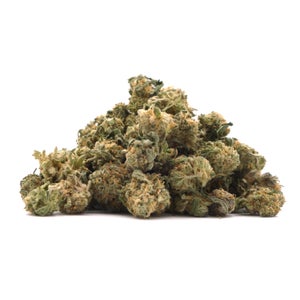


A humidity pack holds the air in your jar at a steady relative humidity (RH), so your flower neither dries to dust nor turns damp. For most people in Canada, a 62% pack in an airtight glass jar is the simple answer. Use 58% if the flower will sit for months. This guide covers the ideal RH range, how to choose between ratings, how to use packs properly and what to do in a dry Canadian winter.
TL;DR
- Aim for roughly 59% to 63% RH inside the jar. That is the range the Ontario Cannabis Store gives for storing cannabis.
- Choose 62% for flower you will finish within a couple of months, and 58% for longer storage.
- Use one pack rating per jar, an airtight glass container and a cool, dark spot.
- Replace a pack when it feels hard, and keep a small hygrometer in the jar so you are not guessing.
- Canadian winters can pull indoor air below 30% RH, so November to March is when packs matter most.
Table of Contents
- What a humidity pack actually does
- The ideal humidity for cannabis
- How to choose the right pack
- How to use a humidity pack, step by step
- Canadian seasons and your jar
- Can a pack rescue dried-out weed?
- Storing spare packs
- If you are drying or curing your own
- Our view on packs
- Keep your stash fresh with our 62% pack
- FAQ
- Sources
What a humidity pack actually does
A humidity pack is a small sachet with a saturated salt solution behind a membrane. As long as both solid salt and liquid are present, the air around it settles at a fixed RH set by the salt, not by how much solution remains. GanjaTech explains that this is why a pack holds its set point until it is nearly spent.
It is a two-way system. If the air is too dry, the pack releases water vapor. If the air is too humid, it absorbs some. The pack is not soaking your flower. It holds the air at a set point so your flower does not have to give up its own moisture to fill the gap.
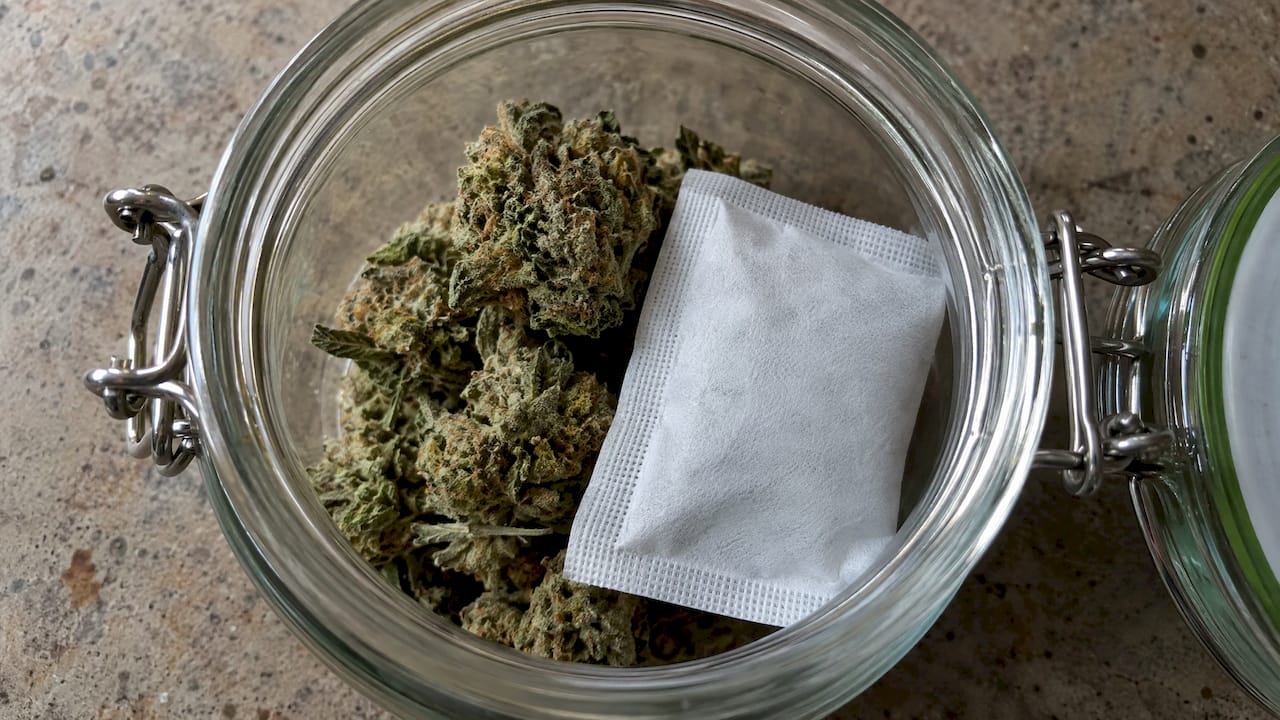
That matters because flower constantly trades moisture with the air in the jar. Too much moisture can let mould and bacteria grow, while too little can break down trichomes and dry out the essential oils, according to the OCS. Those oils are where much of the aroma and flavor lives.
Do you need one?
Not strictly. If you buy a small amount and finish it in a week or two, a clean airtight jar in a cool cupboard is fine. Packs earn their place when you:
- buy larger amounts, such as an ounce deal, and take weeks or months to finish
- live somewhere with very dry winters or very humid summers
- want the flower to smell and burn the same on day 40 as on day 4
If any of those sounds like you, a pack is a cheap way to take the guesswork out.
The ideal humidity for cannabis
The short answer is the high 50s to low 60s percent RH. Different bodies phrase it slightly differently, and the differences are small:
| Source | Recommended range |
|---|---|
| OCS (Ontario) | 59% to 63% RH |
| SQDC (Quebec) | 60% to 66% moisture level |
| Healthline | 59% to 63% RH, airtight glass, dark and dry place |
The provincial retailers land in the same neighborhood, and the SQDC also notes that some producers include moisture regulators you can drop into a jar. In practice, 58% to 62% covers nearly every case, and it is why those two ratings dominate the shelf.
Why 62% is the usual default
A 62% set point balances a smooth burn and good aroma against a safe margin from mould. For a stash you open daily, 62% is the sensible choice. Go much higher and you start to lose that margin. Go much lower and flower turns brittle and harsh.
Why 58% for longer storage
A lower set point leaves more safety margin and slows the loss of aroma compounds over many months. That makes 58% a good pick for flower you plan to keep for a long stretch, or if your home runs humid. Lower still, such as 55%, tends to leave smokable flower brittle, so it is better kept for other uses.
What about temperature?
Keep the jar in a dark, dry place just below 77°F (25°C), per Healthline. A cupboard or drawer away from the stove, a sunny window and the heating vent does the job. Warmer air holds more moisture, so a jar that swings from cool to hot invites condensation inside the glass.
How to choose the right pack
Three decisions cover it: the RH rating, the size and how many.
1. Pick the rating
- 62%: everyday flower you will use within a couple of months.
- 58%: long-term storage, humid homes or extra peace of mind.
Do not mix ratings in one jar. Packs at different set points work against each other and cancel out the benefit. One rating per container.
2. Match the size to the jar
A pack that is too small for the jar cannot keep up, especially after you open the lid and let in room air. Small packs suit a gram or two in a small jar. Larger packs suit bigger jars with more flower. When in doubt, go up a size rather than down.
3. Get a hygrometer
Buy the gauge first and the pack second. A pack with no gauge is an assumption, while a gauge with no pack is still useful information. A small digital hygrometer in the jar tells you if you sit in the 58% to 62% window.
How to use a humidity pack, step by step
- Start with a clean, dry glass jar. Glass with an airtight lid beats bags, which leak moisture and crush buds.
- Fill the jar about three-quarters full. That leaves enough air for the pack to balance, without too much extra oxygen. If you buy in bulk, split the flower across several jars instead of using one giant one.
- Drop in one pack. Place it on top of the flower or tucked at the side.
- Seal and leave it alone for a day or two. Slightly dry flower typically needs 24 to 48 hours or longer to come back into balance.
- Check the hygrometer. Aim for the 58% to 62% window.
- Open the jar only when needed. Every opening lets room air in, which is why a pack in a jar you open ten times a day wears out faster.
- Replace the pack when it hardens. A pack that feels stiff or crunchy has run out of capacity.
If you want a deeper walk-through of jars, light and smell control, our guide on how to store weed covers the full setup. If your order has just arrived, safe storage after weed delivery shows what to do in the first hour.
Mistakes that cause problems
- Storing flower in plastic bags instead of jars.
- Using a pack that is too small for the container.
- Leaving a spent pack in the jar for months.
- Using silica gel, which only dries the air and does not hold a set point.
- Mixing 58% and 62% packs in one jar.
- Keeping the jar in the fridge or in direct sunlight.
The fridge is a common trap. Taking a cold jar out into warm air causes condensation, and moisture on the flower is exactly what you are trying to avoid.
Canadian seasons and your jar
Humidity inside a jar follows the weather outside more than most people expect.
Winter. Heated Canadian homes get dry. A company blog covering Canadian storage, Plantation Premium Seeds, reports indoor RH falling to 20% to 30% in cities such as Ottawa, Winnipeg and Toronto from November through March. In that air, a jar with no pack can lose moisture fast. The University of Saskatchewan likewise notes that Saskatchewan’s dry climate can push RH as low as 20%.
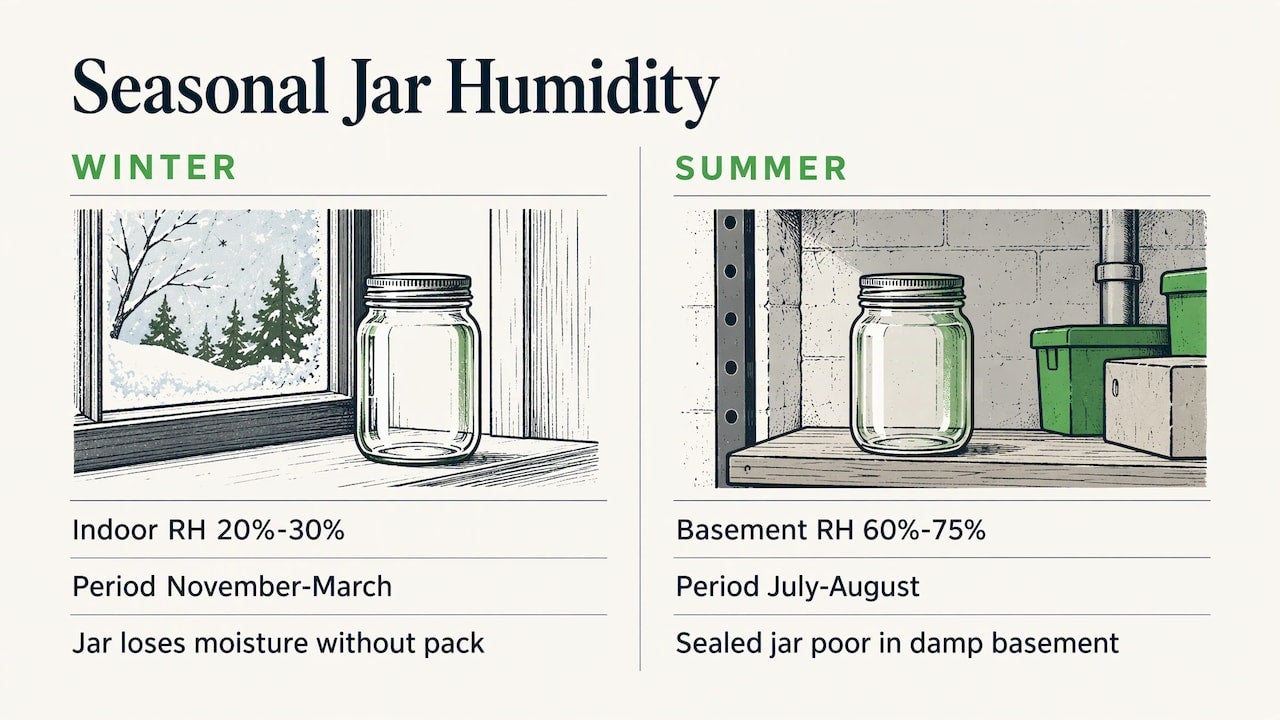
If you are reading this in early November, now is the time to set up your jars. Put a 62% pack in each one before the furnace has been running for a few weeks.
Summer. The same source says basements can reach 60% to 75% ambient RH in July and August. A sealed jar that sits in a damp basement is a poor idea even with a good pack. Keep jars on a main floor, in a cool, dark cupboard, and let the pack absorb the small excess that gets in when you open the lid.
What the rules for licensed producers tell you
Health Canada’s good production practices guide requires licensed producers to keep storage humidity low enough to prevent condensation, and to check temperature and humidity with calibrated devices. You are not a licensed producer, but the same logic works at home: control the humidity and check it with an instrument rather than by feel.
Can a pack rescue dried-out weed?
Partly. A 62% pack can gently rehydrate overdried flower in an airtight jar, usually over 24 to 48 hours or more. It will not restore terpenes that have already evaporated or repair broken trichomes. Think of it as stopping the decline and bringing back some pliability, not turning old flower into a fresh harvest.
Tip: if flower is very dry, give it a few days in a sealed jar with a fresh pack and do not keep opening the lid.
Storing spare packs
Keep unused packs in their sealed original wrapping, or in an airtight container, at room temperature (roughly 60 to 70°F, or 15 to 21°C), away from sun and heat. Stored well, they last a long time, but check the manufacturer’s date on the packaging. Once a pack is open, put it in the jar promptly.
If you are drying or curing your own
The numbers shift a little for drying. The University of Saskatchewan recommends drying cannabis at 16°C to 23°C and 50% to 60% RH, because too much humidity slows drying and encourages fungus such as Botrytis cinerea. A consultant at Dr. Greenhouse describes relative humidity as the lever for water activity: 60% RH corresponds to a water activity of 0.6, which matters for preventing spoilage. Once drying is done, jars and packs take over for storage. Our guide to properly curing cannabis covers that handoff.
Our view on packs
We hear the same thing from customers all the time: the flower arrived great, then a few weeks later it was crumbly or lost its smell. In almost every case, the problem was the jar, not the flower.
Our advice is simple. Treat the pack as part of the purchase, not an afterthought. If you buy an ounce deal or stock up on a few strains, put a 62% pack in each jar the day your order arrives, and keep a small gauge in one of them so you can see what is happening.
We built our service around convenience and privacy: same-day delivery, discreet packaging and a loyalty program for regular buyers. Good storage is the last step in that chain. It keeps what you chose at a fair price tasting the way it should.
the author
Keep your stash fresh with our 62% pack
If you want a ready-made answer for everyday flower, we carry the 62% Boost humidity pack from Integra. Add it to your order alongside your flower, and your jars are set up from day one.

Browsing for something to put in those jars? Our flower selection has ounces starting at $79, and regular buyers can earn rewards through our loyalty program. You can also start from the XpressGrass home page for same-day delivery across Canada in discreet packaging.
If you also keep edibles, heat is the enemy there rather than humidity. Our tips on preventing weed gummies from melting show how to keep them safe in warm weather.
FAQ
What is the best humidity for storing weed?
Aim for about 59% to 63% RH, which is the range the OCS gives. A 62% pack is the usual choice for everyday flower. For storage over many months, 58% leaves a bit more margin against mould.
How long does a humidity pack last in a jar?
It depends on jar size, how often you open it and your home’s air. A pack is spent when it feels hard or the hygrometer drifts out of the 58% to 62% window. In very dry winter air, check more often and swap sooner.
Can I use a 58% and a 62% pack together?
No. Different ratings in one container work against each other and reduce efficiency. Pick one rating per jar. If you keep several jars, you can use 62% in your everyday jar and 58% in the jar you plan to store long term.
Do humidity packs work in plastic bags?
They work far better in an airtight glass jar. Bags let moisture seep in and out, so the pack has to work harder and wears out quickly, and buds get crushed. Move flower to glass as soon as you get it home.
Is it safe to use a pack if my weed already feels damp?
A pack will not fix flower that is already moist or showing mould. If you see fuzzy patches or smell a musty odor, throw it out rather than smoke it. See Healthline’s guide to moldy weed for what to look for.
Sources
- How to Properly Store Cannabis | OCS
- Why and how to store your cannabis | SQDC
- Moldy Weed: What to Look for and How to Handle It | Healthline
- Cannabis Humidity Packs: How to Pick One, and When to Skip | GanjaTech
- Mold on Weed: Bud Rot Prevention | Plantation Premium Seeds
- Good production practices guide for cannabis | Health Canada
- Drying Cannabis | Gardening at USask
- Drying Cannabis: Is There a Science Behind the Art? | Dr. Greenhouse