

A THC vape in Canada is a battery and a cannabis oil cartridge, or an all-in-one disposable, that heats extract into an inhalable vapor. Legal products carry a federal excise stamp, a label showing total THC, and a flavor profile that stays within what Canadian rules allow. Pick the format that fits how often you vape, check the label and stamp, and start low. This guide covers all of that, plus where flavor comes from and how the rules differ between provinces.
TL;DR
- Two main formats exist: 510-thread cartridges that screw onto a rechargeable battery, and all-in-one disposables that need no setup.
- Legal vapes show total THC on the front of the label and carry an excise stamp. No stamp means the product is not legal.
- Flavor in Canadian vapes is meant to be cannabis-typical: strain names and terpene notes, not candy or dessert.
- Health Canada’s guidance for people who vape: use legal, regulated products only, never modify them, and start with one or two puffs.
- Rules vary by province: legal age is 18 in Alberta, 21 in Quebec and 19 elsewhere, and Quebec caps vape THC at 30%.
Table of Contents
- The THC vape formats you will see
- Where cannabis vape flavors come from
- What Canadian rules say about flavor
- How to tell a legal THC vape from an unregulated one
- Safe use: what Canadian health authorities recommend
- A worked example: choosing your first THC vape
- Province by province: what changes
- Our perspective on THC vapes
- Shop vapes with XpressGrass
- FAQ
- Sources
The THC vape formats you will see
Shop any Canadian listing and you will meet the same few formats. Knowing the difference saves money and avoids buying a cartridge that does not fit your battery.
| Format | What it is | Best for |
|---|---|---|
| 510 cartridge | A pre-filled oil cartridge with a standard 510 thread | People who want to swap strains and reuse one battery |
| Battery (510 thread) | A rechargeable power source, often with a USB charger | Anyone using cartridges |
| Vape kit | Battery and cartridge sold together | First-timers who want one purchase |
| All-in-one disposable | Oil, battery and mouthpiece in one sealed device | Convenience, travel, no charging worries |
| Rechargeable all-in-one | A disposable-style device with a USB-C port | Heavier use of one strain without refilling |
510 cartridges and batteries
The 510 thread is the industry standard, so most cartridges fit most batteries. You pick the strain and oil type, screw it on and vape. When the cartridge is empty you replace it and keep the battery. If you like trying different strains, this is the most flexible route.
At XpressGrass you can start with a vape kit with a CO2 oil cartridge, or pick up a battery separately, such as the battery with a screw-on USB charger or the BC Trees battery and charger starter kit.
All-in-one disposables
Disposables skip the pairing step. The category keeps getting more advanced: in December 2025 a national licensed producer launched liquid diamond all-in-one vapes in three 0.95 g versions listing 92 to 98% THC, with a digital display, variable voltage, anti-burn and anti-clog technology and a rechargeable USB-C palm-style body. That shows where the market is heading: bigger oil capacity, better hardware and more potent distillate.
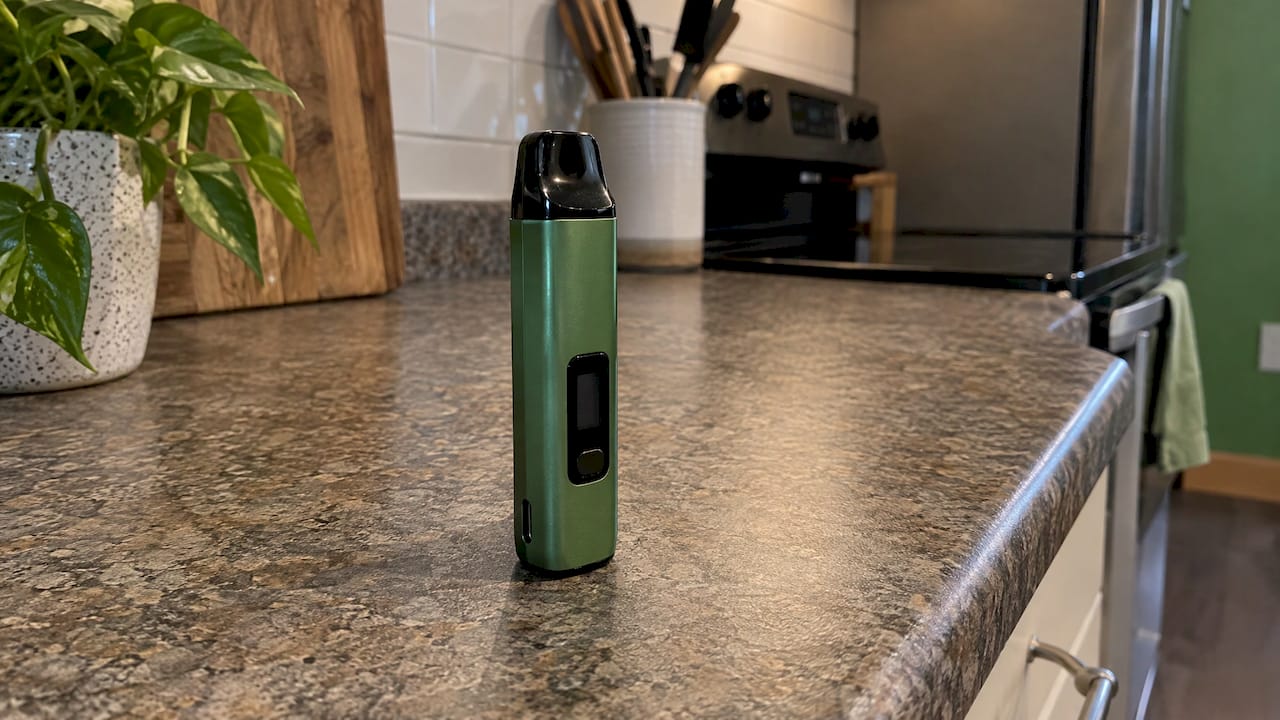
If you want the basics of how a pen heats and delivers extract, our dab pen guide explains it step by step.
Oil types: distillate, liquid diamonds and more
Most vape oil is distillate, a refined extract with a high THC percentage. Newer products add terpenes back in for taste and effect. If you want to understand the oil itself, read our guide on how to use THC distillate. Prefer other concentrate styles for dabbing? Browse the extracts category, or read how to shop for shatter in Canada.
Curious about hemp-derived options? Our Delta 8 THC page covers that topic separately.
Where cannabis vape flavors come from
People search for cannabis vape flavors because the label rarely tells the whole story. Strain names like “pink kush” or “blue dream” describe the flavor family. The taste itself comes from terpenes, the aromatic compounds in the plant.
There are two sources of terpenes in a vape:
- Cannabis-derived terpenes, taken from the plant and added back to the oil after distillation.
- Terpenes from other plants, such as citrus or pine, which can mimic a strain’s profile.
A Washington State Liquor and Cannabis Board brief explains that infusing oil with terpenes from other plants is common because it costs less and gives more consistent results. The same brief notes that terms such as natural, artificial, botanical or synthetic have no legal definition in that market. That is a US observation, but it explains why reading the label for terpene information matters wherever you shop.
Typical flavor families
When you browse THC vape flavors, expect these groups:
- Citrus: lemon, orange and grapefruit notes, often linked to limonene-heavy strains.
- Earthy and pine: classic OG and kush profiles.
- Sweet and fruity: berry, grape and tropical notes that come from the strain’s genetics.
- Gas and funk: fuel-like, pungent profiles popular in potent distillate.
Choose a strain you already enjoy as flower and you will usually like its vape version.
What Canadian rules say about flavor
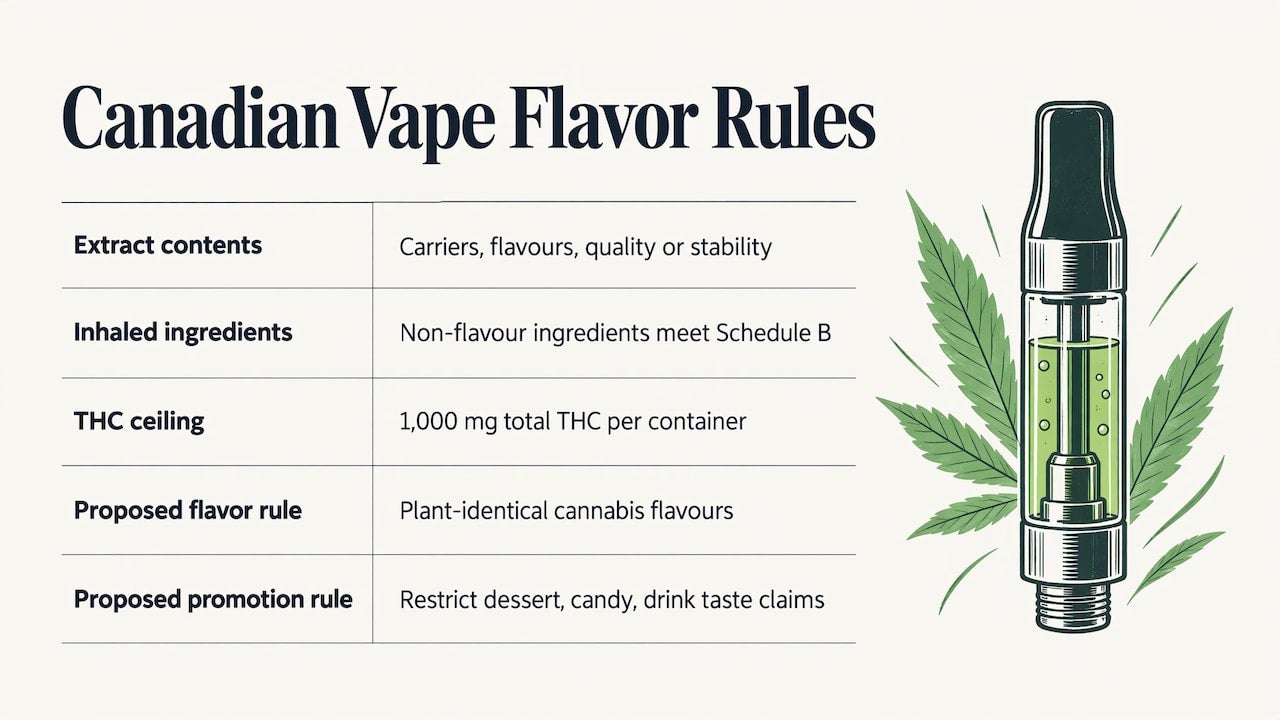
Canada is stricter on vape flavor than many people assume. Under the Cannabis Regulations, section 101.3, a cannabis extract may only contain carrier substances, flavouring agents, and substances needed to maintain quality or stability. In an inhaled extract, any ingredient other than a flavouring agent must meet a standard set out in a Schedule B publication under the Food and Drugs Act.
Health Canada’s composition requirements guide says the same thing in plain terms and also sets the potency ceiling: a maximum of 1,000 mg of total THC per immediate container for all cannabis extracts. That is why a 1 g vape cannot exceed 1,000 mg of THC in total.
A 2021 Canada Gazette consultation proposed going further: limiting flavouring agents in inhaled extracts to substances identical to those found in cannabis, and restricting promotion so a product is not presented as tasting like a dessert, candy or soft drink. It would still allow factual descriptors, strain names and terpene content statements. Treat that as a proposal and check Health Canada for the current status. The practical point stands: in Canada, flavor is about the plant’s own character.
How to tell a legal THC vape from an unregulated one
This is the most useful check you can make, and it takes ten seconds.
Check the label
Health Canada explains that the front of a legal label must show total THC and total CBD, along with a health warning message in a yellow box. If the package lacks a standardized label, it is not a regulated product.
Look for the excise stamp
The Canada Revenue Agency states that the excise stamp shows federal duty has been paid and the product was produced legally. Its security features can only be detected by law enforcement, and no one can sell or possess a cannabis product without the right stamp (with exceptions for low-THC cannabis and prescription drugs). British Columbia tells consumers to look for the green provincial stamp and says that if there is no stamp, the product is not legal.
Why it matters
Health Canada notes that in 2019 an unregulated cutting agent, vitamin E acetate, was used in illegal THC vape products and was linked to the EVALI outbreak in the United States, which caused thousands of hospitalizations and dozens of deaths. Regulated products are tested against composition rules precisely to prevent that kind of problem.
Safe use: what Canadian health authorities recommend
Canadian authorities are cautious about vaping and say so. The Council of Chief Medical Officers of Health says the safest approach is to avoid smoking or vaping cannabis extracts. For adults who choose to vape, the same guidance gives a clear way to do it more carefully:
- Use products from legal, regulated sources only.
- Do not modify the product or add substances.
- Begin with one or two puffs of a vape at 10% (100 mg/g) THC or less.
- Read the label.
- Avoid deep inhalation and breath-holding.
- Avoid mixing with alcohol.
Health Canada’s page on cannabis accessories for inhalation adds that vaping aerosol has been shown to contain harmful substances and that contaminants such as heavy metals can leach into extract, while also stating that vaping is less harmful to the lungs than smoking cannabis.
Its 2019 advisory asks anyone who vapes to watch for cough, shortness of breath or chest pain and to seek medical attention promptly. It also says non-smokers, people who are pregnant and young people should not vape. Health Canada also warns that disposable pens can contain up to 95% THC and that THC can harm brain development until the mid-20s. If you have a lung condition or are unsure whether vaping suits you, talk with your doctor or pharmacist first.
A worked example: choosing your first THC vape
Say you are an experienced flower consumer who wants a discreet, low-fuss option.
- Pick the format. If you want to try several strains, buy a battery and a couple of cartridges. If you want zero setup, choose a disposable.
- Pick the potency. Health Canada’s guidance suggests starting with a vape at 10% THC or less. Distillate products commonly list far higher numbers, so read the front label first.
- Pick the flavor family. Match it to a strain you already like.
- Verify the package. Look for the excise stamp and the yellow health warning box.
- Take one or two puffs and wait. Inhaled effects are fast, but give yourself time before deciding on more.
- Store it upright and away from heat, and keep it out of reach of children and pets.
The same logic applies when you move to higher-potency devices later: the label tells you the number, and your own tolerance tells you the dose.
Province by province: what changes
Cannabis law is federal, but retail and age rules are provincial. According to a 2026 summary of Canadian cannabis laws, the legal age is 18 in Alberta, 21 in Quebec and 19 in every other province and territory. Always confirm with your province’s official site.
Quebec deserves its own note. Its provincial retailer was set to begin selling vapes on November 26, 2025, with products subject to a 30% THC cap and no added flavours beyond cannabis-derived terpenes already in the product. The decision was framed as offering a lower-risk alternative to unregulated vapes. A 2024 survey reported that 25% of Quebec cannabis consumers were already vaping despite the earlier ban.
A quick background: the Cannabis Act came into force on October 17, 2018, and extracts, edibles and topicals became legal on October 17, 2019, which is when legal vapes became possible in most of the country.
Our perspective on THC vapes
We see the same thing in every conversation about vapes: people want something discreet, convenient and consistent. A well-made cartridge or disposable delivers that better than almost any other format, which is why vapes keep growing as a category.
Our view is simple. Buy from a regulated source, read the label, and choose a flavor profile that comes from the plant. When you do that, the product does what you want it to do and you know what is in it.
That is how we build our catalog and our service. We offer flower, edibles, extracts, vapes and accessories in one place, with discreet packaging and same-day delivery across Canada, so a reorder is as easy as the first order. Our loyalty program is there for people who come back, because the best customers are the ones who find a product they trust and stay with it.
the author
Shop vapes with XpressGrass
If you are ready to try a THC vape, we carry kits, batteries, cartridges and a full range of other products. Our shopping experience is built to be simple, our packaging is discreet, and same-day delivery is available across Canada. Frequent buyers earn rewards through our loyalty program.
Start with the full shop to browse every category, or head to XpressGrass to see what is new. If you are weighing bulk options, our guide on how much an ounce of weed costs is a good next read.
FAQ
Are THC vapes legal in Canada?
Yes, for adults of legal age, when they are sold by licensed retailers and made by licensed producers. Extracts, including those used in vapes, became legal on October 17, 2019. Legal products carry an excise stamp and a standardized label.
How strong is a THC vape in Canada?
Federal rules cap an extract container at 1,000 mg of total THC. Disposable pens can list very high percentages, and Health Canada says some contain up to 95% THC. Check the front label for the total THC figure before you buy.
Can a THC vape be flavored like candy?
Canadian rules limit extract ingredients to carriers, flavouring agents and stability substances, and a federal proposal aims to keep inhaled flavors cannabis-typical. In practice, flavor comes from strain-specific terpenes, and labels use strain names and terpene descriptions.
What is the difference between a cartridge and a disposable?
A cartridge screws onto a reusable 510 battery, so you can swap strains and keep the hardware. A disposable is a sealed all-in-one device that needs no setup. Cartridges suit variety, while disposables suit convenience.
How do I vape THC more safely?
Buy only legal, regulated products, never modify them, and start with one or two puffs of a vape at 10% THC or less. Avoid deep inhalation, breath-holding and alcohol. If you notice cough, chest pain or shortness of breath, seek medical attention promptly.
Sources
- Canopy Growth launches Claybourne Gassers liquid diamond all-in-one vapes
- Flavored Cannabis Vape Products, Washington State LCB research brief
- Cannabis Regulations, section 101.3
- Guide on composition requirements for cannabis products, Health Canada
- Canada Gazette, Part 1, Volume 155, Number 25
- How to read and understand a cannabis product label, Health Canada
- EDN61 Excise Stamping Regime, Canada Revenue Agency
- Talking with your teen about vaping, Health Canada
- CCMOH statement on cannabis extracts, edibles and topical products
- Cannabis accessories for inhalation, Health Canada
- Information Update on pulmonary illness and vaping, Health Canada
- Cannabis producers launch an array of unique vapes for Quebec market
- Quebec Allows Cannabis Vape Sales by Year-End
- Cannabis Laws in Canada 2026
- Canada cannabis legality guide